• 3 minutes read
The Day Our Early Team Member Quit (And Left Behind 30TB of Massive Files)

A few months ago, one of our early team members—let’s call him S—decided it was time to move on.
S had been with us for years. He was the guy who knew every vendor, every early customer, and the backstory behind every major campaign we’d ever run. When he handed in his notice, we did what every company does: we scheduled the handover meetings, created the transition docs, and made sure we had access to all his accounts.
On his last day, he handed over the keys to the kingdom:
Access to 2 different email inboxes
Over 6 years of internal chat history
A Dropbox folder containing over 30 Terabytes of files
"Everything you need is in there," he said.
And technically, he was right. Everything was in there. But practically? It was completely useless.
When a key person leaves a small team, the financial hit is obvious. I was reading a report from SHRM recently that quantified it: replacing a single employee costs anywhere from 50% to 200% of their annual salary. But honestly, that number feels low when you're a team of five or ten people. That's just the cost of recruiting, hiring, and training a warm body to sit in the empty chair. It doesn't even begin to account for the invisible cost—the sheer volume of institutional memory that just walked out the door, got into an Uber, and went to work for someone else.
The Illusion of the "Handover"
When you lose a co-founder, a founding engineer, or your first GTM hire, the stress is immediate. Both for the founder who has to fill the gap, and for the poor soul who has to take over the role.
We tell ourselves that as long as we have the files, we haven't lost the knowledge. But that’s a lie.
A week after S left, I needed to know why we had chosen a specific agency two years ago over a competitor. I had the contract in Dropbox. I had the email threads. I even had the chat messages where the decision was made.
But I couldn't find the why.
The actual decision-making logic—the nuance of the relationship, the unwritten red flags about the competitor, the context of our budget at that specific moment in time—wasn't in a document. It was in S's head. And S was gone.
Those 30 Terabytes of files weren't a knowledge base. They were a graveyard.
Dead Knowledge vs. Living Context
This is the reality for almost every fast-moving startup or small team.
For a massive corporation, losing one person is a blip. There’s redundancy built into the system. But for a team of 5 or 10 people? Losing one person means losing 20% of your company's brain trust overnight. It can be fatal.
We live in an era of super-individuals and lean teams. We move fast, we iterate constantly, and we don't have time to write exhaustive wikis for every decision we make. Our knowledge lives in the flow of work—in quick Slack messages, in email threads, in shared docs, and most importantly, in the connections between those things.
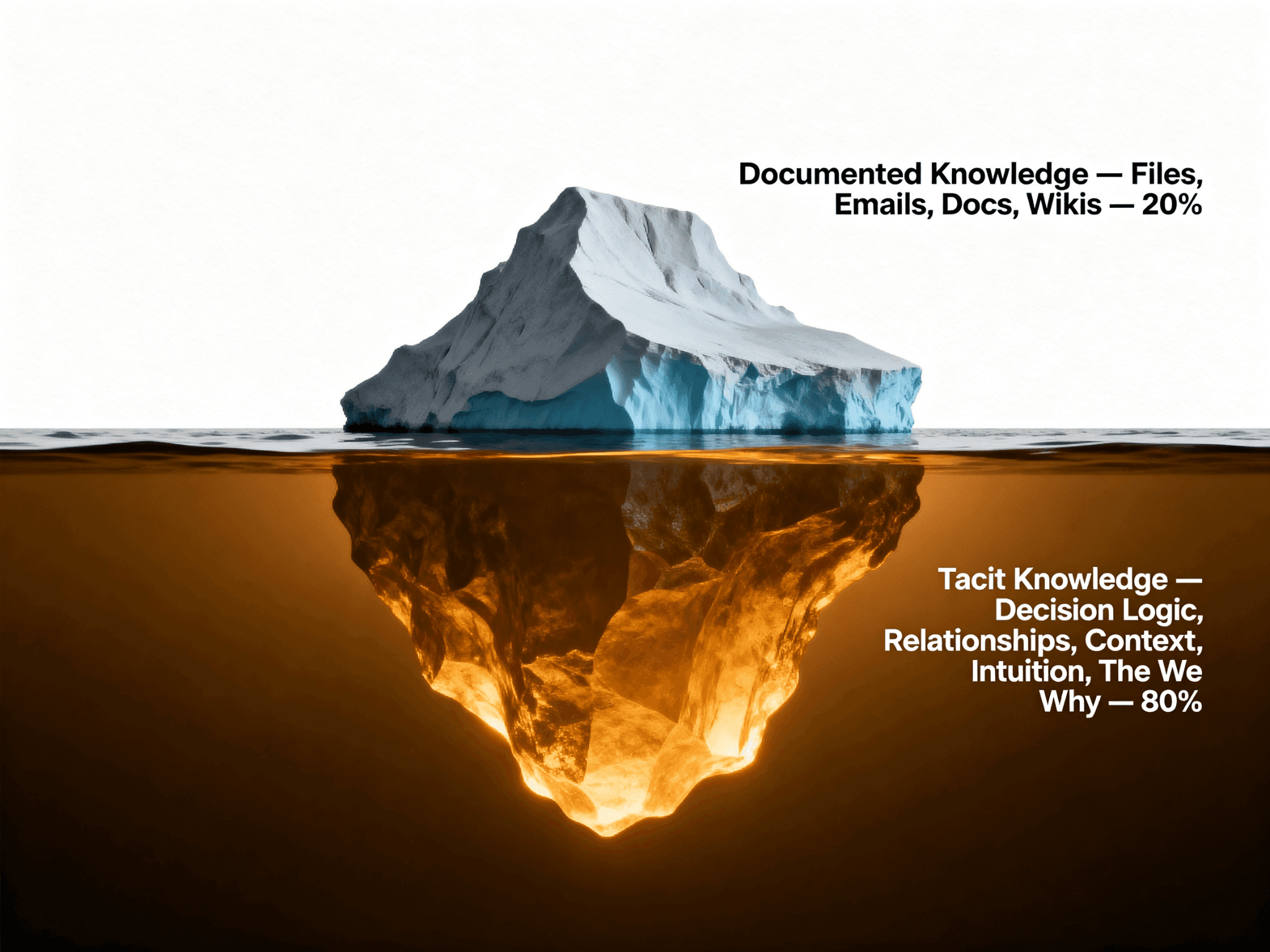
The problem isn't that S was bad at documentation. The problem is structural. Research shows that up to 80% of a company's knowledge is tacit—it lives entirely in people's heads, not in documents or databases. It's the "gut feeling" about a client, the historical context of a failed experiment, the unwritten rules of how to get things done. You can't put 80% of your company's brainpower into a Google Doc during a two-week notice period. It's impossible.
When a key person leaves, you don't just lose their output. You lose their context.
We Needed the Person, Not the Files
Staring at those 30TB of files, I realized something fundamental: I didn't want a better search engine. I didn't want a more organized folder structure.
I wanted to be able to ask S a question.
Because searching through files is a miserable, soul-crushing way to work. McKinsey did a study on this and found that employees spend an average of 1.8 hours every single day—nearly 20% of the workweek—just searching for information. And that's on a normal day. When a key person leaves, that number spikes for everyone around them. Suddenly, you're spending three hours digging through someone else's chaotic folder hierarchy just to find the hex code for the company logo or the login for the webinar software.
You can search a Google Drive for a keyword, but you can't ask a Google Drive: "Hey, what was the vibe with this client last year? Should I push them on pricing?"
You can scroll through years of Slack history, but you can't ask a Slack channel: "Why did we build this feature this way instead of the obvious way?"
Files give you the what. But to keep moving fast, you need the why.
That realization is why we built Relay.
We realized that the technology finally exists to stop treating offboarding as a file-transfer exercise. Instead of just archiving a departing employee's digital footprint, what if you could turn it into an interactive AI?
What if you could take those emails, those chat logs, those thousands of documents, and use them to reconstruct the context of the person who created them?
Not a wiki. Not a search bar. An actual AI twin that you can talk to, that knows what they knew, and can explain why they did what they did.
We built Relay because we were tired of watching our most valuable asset—the tacit knowledge of our best people—walk out the door.
If you're a founder, a CEO, or a team lead, you know exactly the anxiety I'm talking about. You know the dread of that "Can we chat?" message from a key employee.
You can't stop people from leaving. But you don't have to let their knowledge leave with them.